


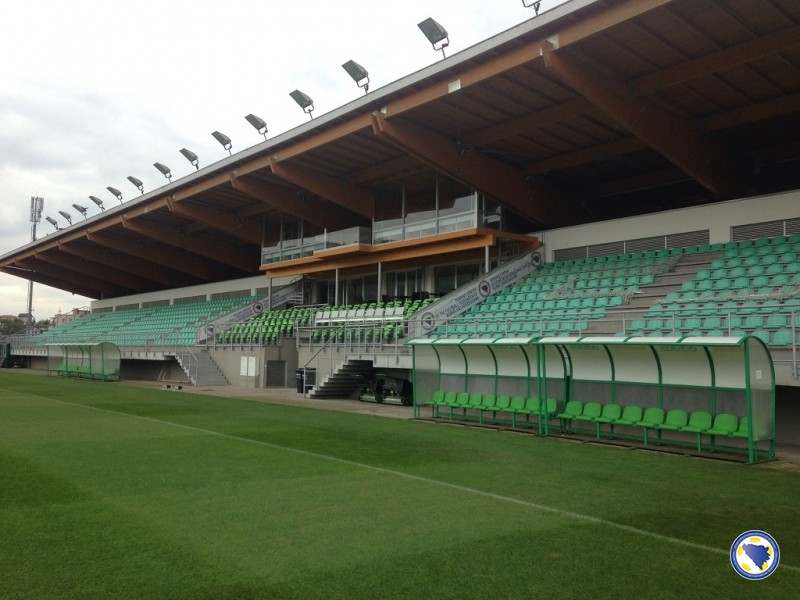
Creating better conditions for training and playing would certainly influence the development of future BH stars, but also give spectators the opportunity to enjoy a more attractive football.
Nihad Hodžić, the secretary of the Executive Board and the acting professional associate for stadiums and safety has been involved in the implementation of all infrastructure projects for years and can certainly provide adequate answers to some questions.
FF BH invested significant funds in the infrastructure of the clubs that compete in the BH PL in the past period. Can you specifically say what was done and how much did it cost?
“This project was launched during the 2014/2015 season, when FF BH created a program of assistance to clubs of the BH Premier League to improve infrastructure. We also received the UEFA support, and access to the funds used for realizations.
The whole project included 21 clubs together with the local communities. One of the conditions for obtaining funds was also a participation of local communities, from which the clubs come. We established a certain procedure, clubs applied to get a part of the funds they were obliged to invest in improving the infrastructure based on individual priorities. Therefore, after FF BH approved clubs a certain amount, the local communities, from which the Premier League clubs come, should invest at least 1/3 of those funds in the project realization.
Total participation of FF BH through the UEFA funds amounted to 1,326,000.00 EUR. Local communities invested more than 1/3 of the mentioned amount, so according to real estimations, about 4,000,000.00 BAM were invested in the complete project.
I would like to emphasize that the wishes of the clubs and local communities have been fully respected and, among other things, during the realization of the project, two large pitches with artificial turf (FK Borac and FK Velež) were made, and one small pitch with artificial turf (FK Sloboda). The automatic watering systems were installed at eight stadia; complete reconstructions were made on two pitches, and the entire service on eight pitches. Renovation of stands or facilities below them (dressing rooms, public toilets, VIP areas, etc.) was done at five stadia.
We can be proud of cooperation with clubs and local communities, because without them it would be impossible to do all this. The project was implemented in full, and a new project is ahead of us, in which the Federation will invest funds so that the floodlights will be installed at the stadiums for the Premier League matches.
The project was designed and approved by the FF BH Executive Board. The Federation will provide a photometric calculation, procurement and installation of floodlights and issuing certificates of the illumination. Clubs and their local communities are obliged to build an appropriate substation, then to procure and distribute the cables and distribution cabinets, as well as to procure and install the pillars on pre-built foundations.
The value of the FF BH participation is around 230,000.00 BAM per stadium, and the participation of the clubs and the local communities is about 450,000.00 BAM per stadium. It is planned to make 4-5 stadiums of the Premier League, one perspective stadium from each Entity League, and reconstruct of installations and floodlights on 2-3 stadiums with existing floodlights, for which, through the elaborate study, the poor condition of the installations and the degradation of the lighting fixtures was determined.”
As a stadium expert, can you describe how a modern football pitch should look like?
“A modern football pitch contains high-quality drainage, drainage layer, sandy layer (100% river or quartz sand), instalment of the heating system placed in the bottom of the sandy layer (pipe system or electric heaters), bushed grass. At the top of the scale of quality are certainly hybrid lawns, i.e. lawns composed of a combination of natural grass and artificial turf. There are two basic types of hybrids, but we will tell about them with more details in one of the following conversations. Hybrid lawns are at majority of important stadia in Europe.
For a high-quality pitch, in addition to exceptional construction, a good and expert maintenance is required, including adequate machinery, equipment and tools, and trained workers. The price of the purchase of quality machinery (tractor with connecting equipment, field drill, aerator, vertikut, various tools) is from 150,000.00 to 200,000.00 BAM.
The costs of the annual pitch maintenance are around 150,000.00 BAM and are related to the costs of depreciation of mechanization, its servicing, labour staff costs, procurement of materials (fertilizer, sand, seeds, herbicides, etc.). All this is said from the expert aspect, but to have a picture of how a perfect lawn looks like, look at the Park of Princes Stadium in Paris, which, according to the footballers, was the best in the past EURO in France.
Of course, we are still far from having such pitches in Bosnia and Herzegovina, but the “Bilino Polje” Stadium has quite a good pitch, and therefore the “A” national team plays its matches there.”
When you have already mentioned the “A” national team, it is known that our best team could not play its qualification matches at the “Bilino Polje” or “Grbavica” stadium until the appropriate infrastructure conditions at these stadia have been improved. What preconditions were to be fulfilled, and what is the contribution of clubs and local communities in these investments?
“The “Bilino Polje” Stadium has been intensely improving since 2004, when the dressing rooms and the north and south stands were reconstructed and the individual seats for all stands were purchased. From then till now, the following was done in stages: reconstruction of the roof above the west stand, reconstruction of the VIP area and the press tribune on the east stand, upgrading of the TV studio and the control room, reconstruction of the main pitch, reconstruction and intensification of floodlighting, installation of the sound system, video controls and turnstiles at the gates, traffic lights and so on.
So far, the local community invested about 3,000,000.00 BAM, and FF BH about 2,500,000.00 BAM.
The “Grbavica” Stadium has not yet reached the equipping level that the “Bilino Polje” Stadium has, but in the last two years a significant shift has been made thanks to the new management of FK “Željezničar”. In particular, reconstruction of the existing west stand and the upgrading of new premises (TV studio, control room, expanded room for media activities) were completed, a new east stand was built, and so on. I would also like to remind that FF BH financed the intensification of floodlighting in the amount of 230,000.00 KM for the EQ match with the national team of Belgium.”
Three years ago, an initiative was launched, but also a mini-pitch project for institutions that take care of people with special needs. How do those pitches look like today, whether the entire project is completed or it will be continued in this year?
“It should be said that we previously had similar projects. Namely, twelve-thirteen years ago, from the UEFA HatTrick program, together with the regional and cantonal football federations, we built 40 mini-pitches throughout BH. Of course, all of this has been already said and we repeatedly emphasized the importance of the project, with which we helped to build mini-pitches at the institutions for children with special needs. In accordance with the UEFA’s constant tendency to support and promote the involvement of all in football, we also wanted to contribute to the creation of better conditions for sport and, in general, inclusion in sport of persons with disabilities through this project. So, these are projects that have been entirely completed and according to the information we received, the pitches are more or less in satisfactory condition.”
As someone who has been involved in the construction of the FF BH Training Centre from the beginning, can you say what it means today for the functioning of the Federation, what is its profitability and, finally, the occupancy rate during the year?
“The functioning of the FF BH Training Centre in Zenica has shown the full justification of its existence in these four years. The fact that we have our training camp, whose capacities are fulfilled almost twelve months a year, leads us to think about building one more pitch and expanding the accommodation capacity that now has 24 double rooms.
Comparing the costs that we had earlier, when we gathered all national teams, when we were without a training centre and now, we came to the data that the number of gathering was about 45-50% higher and that the costs of these gatherings did not increase dramatically. For us, this is a huge saving, not to mention the possibility of playing official games and tournaments of all selections, except the “A” national team.
Speaking in figures for 2016, the Training Centre was occupied for 160 days and in 2017 we had activities that took place for 274 days. I will also add that during the past year, 32 matches were played at the Training Centre.
We believe that successes that our youth teams reached during the last three or four years, among other things, are the result of these more numerous and more quality gatherings and trainings.”
During construction, and also today, it was often commented on why the Centre was built in Zenica and not in Sarajevo. Can you explain this once again, although this is less important now, since TC in Zenica justified the purpose of its construction?
“I have to return in 2002 when we searched for a location and a partner, a local community. In that period there were many talks about this, but in short, the condition for obtaining the funds from UEFA and FIFA was to provide a free location and to release the project from tax obligations. The first interesting location was in Breza, but the size was not satisfactory (min.30.000m²), and we could not get it free of charge.
Then we had two locations in Sarajevo, on the territory of the Municipality of Centar and the Municipality of Ilidža, and I must repeat that despite numerous meetings and discussions at all levels, we did not find the readiness of local communities in the Sarajevo Canton to resolve this issue.
Finally, in 2007, in the negotiations with the Municipality of Zenica, we came to an agreement between the Zenica Municipality and FF BH on the joint implementation of the project of building a Training Centre.
I should also point out one important fact, that is, the average winter temperatures are higher for several degrees in Zenica than in Sarajevo, that the number of foggy days is much lower in Zenica than in Sarajevo, and that the level of pollution on the Crkvičko Brdo in Zenica, where the TC is located (due to configuration) far less than in Sarajevo.
If we look at these elements, then it is quite certain that we did not make a mistake in choosing a location for the construction of the FF BH Training Centre.”
In 2015, FF BH bought a new office building, in which, after the adaptation, the administration should move. Why has this not yet occurred and is there any idea what will all be in this area of 5,900 m2?
“One of the successful business moves of the FF BH management was the purchase of a new administrative building. This facility, which belonged to the Geodetic Institute of BH, is located in the Sarajevo Municipality of Novi Grad, and it was purchased through judicial sale at a public auction in April 2015.
The elaborate on the existing condition of the facility and then the project documentation was prepared, in order to start the tender procedure of the 1st phase of reconstruction and adaptation of the facility at the end of 2016. Although we had several public tenders for contractors, we only managed to complete all procedures at the beginning of this year and sign agreements with the best bidders. After finishing certain administrative tasks, the works on the building will begin during February. As already mentioned, it is about the 1st phase of the works that include both the new façade and works on about 40% of the interior surface of the building.
Majority of the premises of the new “House of Football” will naturally be used by FF BH for its works. I would like to remind that there will be, among other things, a convention centre with three halls, a museum, a trophy hall, a fan shop, an underground garage, green areas, etc. At this moment, we are doing analyses that will help us to decide for which purpose is best to use the rest space. Reconstruction of the facility should be completed in six months.”


